A photographic journey · October 2026
AmazonLife in the Rainforest
A photographic journey through the Amazon and Rio Negro
Begin the journey218 photographs / 8 chapters
Life gathers at the water’s edge, climbs into the canopy and continues in the shade beneath it. These photographs move from Belém’s waterfront to the forests and waterways of the Rio Negro, bringing animals, plants and people into the same story.
2–4 October 2026 · Belém and Pará
Belém: at the river’s doorstep
The story begins where river traffic, market stalls and tropical plants meet. Belém’s waterfront is part of the Amazon’s daily rhythm; gardens and enclosures also offer close views of animals that are much harder to see in the forest. Beyond the city, narrow channels lead past wooden landings, cacao trees and palms.
34 photographs · 001–034
A perch on the waterfront
A great egret (Ardea alba) takes a lookout on a boat railing in Belém, where city life meets the river.
Pineapples on the move
A handcart piled with pineapples (Ananas comosus) makes its way through Belém.
A market by the water
Watermelons (Citrullus lanatus), handcarts and moored boats share the scene at Belém’s waterfront market.
An elaborate flower
A cannonball tree (Couroupita guianensis) opens a fleshy pink-red flower, its curved hood crowded with stamens.
The tree’s namesake
Round, woody fruits cluster against the trunk of a cannonball tree (Couroupita guianensis). Their hard shells explain the name.
Flowers changing colour
Likely Rangoon creeper (Combretum indicum), an ornamental climber whose flowers change from white through pink to red as they age.
Worn orange wings
Probably a Julia butterfly (Dryas iulia), resting with its worn wings spread in Belém.
A pause on lantana
A Julia butterfly (Dryas iulia) visits lantana flowers (Lantana sp.). Adults take nectar, while their caterpillars feed on passionflower vines.
White pinwheels
A pinwheel-flowered shrub (Tabernaemontana sp.), probably crape jasmine (T. divaricata), blooms among glossy leaves.
A coiled proboscis
A passion-vine butterfly (Heliconius sp.) rests on a leaf, its proboscis coiled beneath its head. Several related species share this striking pattern.
An eye in the shade
An owl butterfly (Caligo sp.) rests with its wings folded, revealing a large eyespot against a mottled brown underside.
Green, yellow and blue
An orange-winged amazon (Amazona amazonica) perches on a wooden fence in Belém.
Orange over yellow
A Julia butterfly (Dryas iulia) spreads its wings above yellow lantana flowers (Lantana sp.).
A spectacled face
A spectacled owl (Pulsatrix perspicillata) rests in a shaded enclosure, its white facial markings sharp against the dark head.
Time to preen
Two black-bellied whistling-ducks (Dendrocygna autumnalis) float together, one turning back to tend its feathers.
Powdery green
A mealy amazon (Amazona farinosa) looks back from its perch. The pale, powdery cast of its feathers gives this parrot its name.
Hanging beneath a branch
A two-toed sloth (Choloepus sp.), probably Linnaeus’s two-toed sloth (C. didactylus), hangs beneath a branch in Belém.
Among sunlit leaves
Probably Linnaeus’s two-toed sloth (Choloepus didactylus), suspended among leaves with its hooked claws keeping a secure hold.
The next branch
A two-toed sloth (Choloepus sp.), probably C. didactylus, reaches between branches.
An upside-down portrait
Probably Linnaeus’s two-toed sloth (Choloepus didactylus), looking out from beneath the leaves. Two long foreclaws anchor each front foot.
Through the branches
A two-toed sloth (Choloepus sp.), probably C. didactylus, stretches upward through a lattice of branches.
A seed carrier
An agouti (Dasyprocta sp.) sits among palms and fallen leaves. Seeds it buries and leaves behind can grow into new trees.
Waxy pink bracts
Torch ginger (Etlingera elatior) flowers in a Belém garden. The large pink bracts surround much smaller flowers.
Leaves like floating trays
Giant waterlilies (Victoria sp., probably V. amazonica) spread their raised-rim leaves across a pond, with a pink flower between them.
A jaguar at the threshold
A jaguar (Panthera onca) stands among fallen leaves at the entrance to its enclosure, its rosettes distinct against the shaded background.
A channel between homes
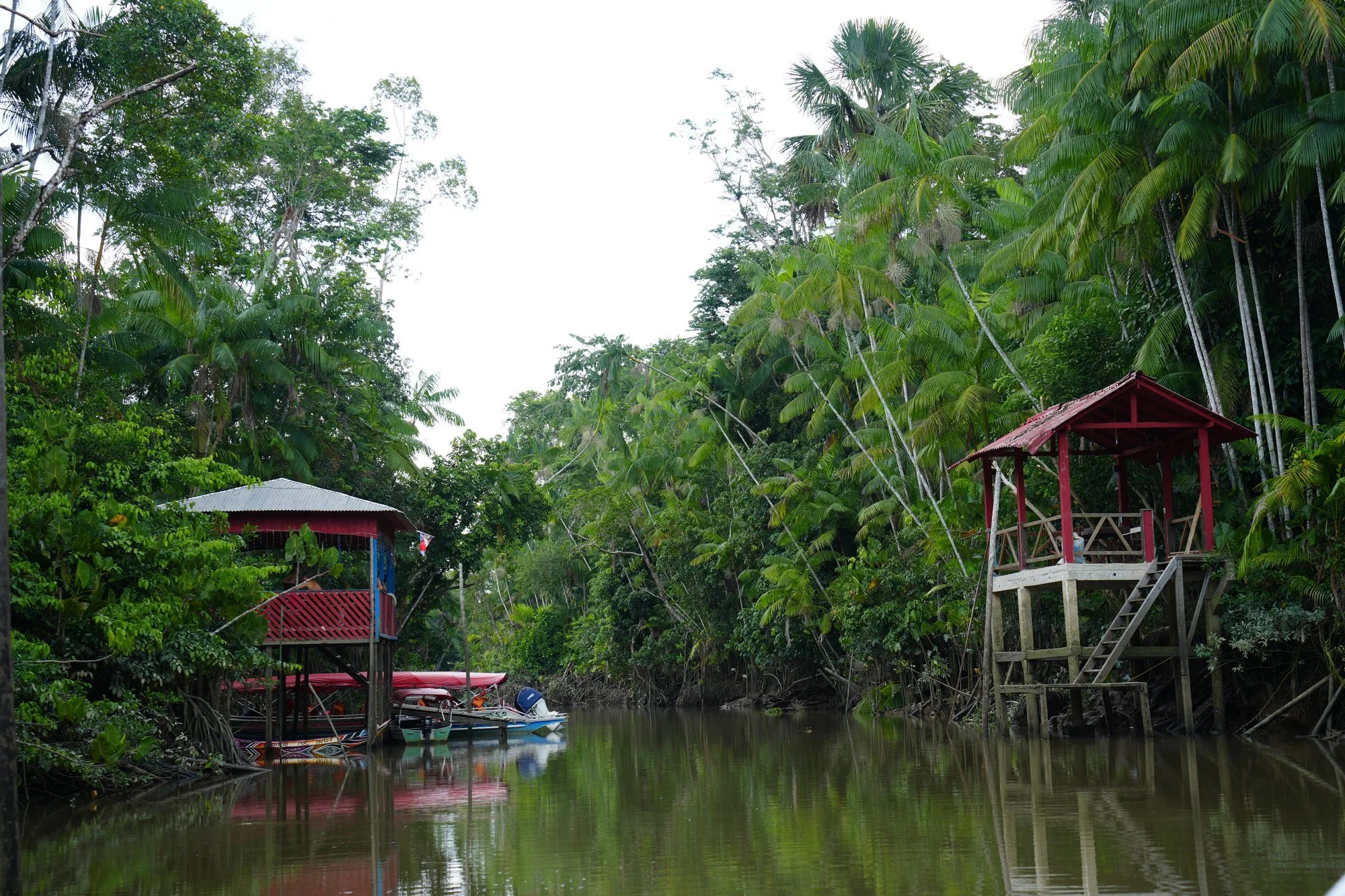
Boats and wooden landings line a palm-fringed channel near Belém. Here, the water is a route between homes and the wider river.
A familiar neighbour
A calico cat (Felis catus) rests on a wooden floor beside the waterways of Pará.
Cacao on the branch
Green cacao pods (Theobroma cacao) grow directly from woody branches. Their seeds are the starting point for chocolate.
A roll in the sand
A domestic dog (Canis lupus familiaris) rolls on sandy ground in a riverside settlement.
Opening Brazil nuts
Hands work with a machete to open Brazil nuts (Bertholletia excelsa), releasing the kernels from their tough shells.
Fruit of the estuary
Probably an açaí palm (Euterpe oleracea), its dark fruits hanging from a branching stalk. Their pulp is an important food in the Amazon estuary.
Climbing toward the light
Twisted, ribbon-like lianas cross the understory, using the surrounding trees for support.
Flowers on a trunk
Likely a jackfruit tree (Artocarpus heterophyllus), with elongated flower heads growing from short shoots on its trunk.
At the foot of a giant
A broad, buttressed tree rises into the canopy, its trunk and branches supporting smaller plants along the way.
5 October 2026 · Near Manaus
The river opens
Open banks reveal a different community. Terns cross the water, kites watch from bare branches and jacanas pick their way over mud and floating plants. Fishing connects the river to life on shore, while monkeys and an owl draw attention back into the trees.
25 photographs · 035–059
Wings on the riverbank
A yellow-headed vulture (Cathartes sp., probably C. burrovianus) spreads its wings on an exposed bank near Manaus.
Red against fresh green
A male red-breasted meadowlark (Leistes militaris) stands among new shoots on a muddy bank.
Low over the water
Two large-billed terns (Phaetusa simplex) skim a river channel, their heavy yellow bills and bold wings clearly visible.
A broad-winged glide
Likely a lesser yellow-headed vulture (Cathartes burrovianus), gliding with its broad wings spread above the river margin.
Toes made for wetlands
A wattled jacana (Jacana jacana) steps across mud. Its exceptionally long toes also spread its weight over floating vegetation.
A specialist’s bill
A male snail kite (Rostrhamus sociabilis) watches from the foliage. Its deeply hooked bill can draw freshwater snails from their shells.
Watching the wetland
A black-collared hawk (Busarellus nigricollis) perches above sunlit grasses. Fish make up much of this raptor’s diet.
A bare-branch lookout
Probably a roadside hawk (Rupornis magnirostris), watching from an exposed branch in Amazonas.
A rest on driftwood
A snail kite (Rostrhamus sociabilis) rests on driftwood beside the water, its curved bill outlined against the background.
White wings in flight
A western cattle egret (Ardea ibis) flies with its neck folded and legs trailing.
A shared stretch of bank
A great egret (Ardea alba), two black-bellied whistling-ducks (Dendrocygna autumnalis) and a wattled jacana (Jacana jacana) share the riverbank.
At the end of the branch
A snail kite (Rostrhamus sociabilis) surveys the water from the tip of a fallen branch.
White among the leaves
A great egret (Ardea alba) rests high in sunlit foliage.
Two fishing stations
Two Amazon kingfishers (Chloroceryle amazona) occupy bare branches above the water, watching from different heights.
Green backs, white collars
Another view of two Amazon kingfishers (Chloroceryle amazona), with their shaggy crests and white collars in profile.
A catch from the river
A silver arowana (Osteoglossum bicirrhosum) hangs in a fishing net, its large scales and paired chin barbels visible.
A pause in the canopy
A squirrel monkey (Saimiri sp.) sits on a branch, its long tail hanging below. Fruit and insects are among its foods.
A careful grip
A squirrel monkey (Saimiri sp.) holds slender stems above a thick branch, its black-tipped tail curving beneath it.
Framed by branches
A squirrel monkey (Saimiri sp.) pauses in a branch fork near Manaus.
A balancing tail
A squirrel monkey (Saimiri sp.) sits above the bank, its long tail helping it balance among the branches.
Russet in the canopy
A red howler monkey (Alouatta sp.) rests partly hidden by leaves.
Rest between meals
A red howler monkey (Alouatta sp.) crouches in the canopy. Long rests help conserve energy on a diet rich in leaves.
An owl in daylight
A screech-owl (Megascops sp.) rests in the shade, its yellow eyes and small ear tufts emerging from finely patterned feathers.
Two quiet scavengers
Two black vultures (Coragyps atratus) share a forest branch near Manaus.
A white-headed lookout
A male white-headed marsh tyrant (Arundinicola leucocephala) stands on a snag, a small flycatcher at the wetland’s edge.
5–7 October 2026 · Manacapuru and the waterways of Amazonas
Living at the river’s edge
The banks hold many kinds of life: frogs and snakes among the stems, fruit and flowers around settlements, and waterbirds resting between fishing trips. A caiman with its catch makes the food web visible. A dolphin offers something much briefer—just enough of a back to register before it slips below the surface.
25 photographs · 060–084
Clinging after dark
A tree frog, probably a species of Boana, grips a slender twig with its expanded toe pads.
Face to face with a frog
A tree frog (family Hylidae) faces the camera from a green stem, broad mouth and large eyes framed by darkness.
Coils among the leaves
A boa constrictor (Boa constrictor) lies among branches and dry leaves, its reddish tail tucked against the patterned body.
A bright patch on the back
A male three-toed sloth, probably a brown-throated sloth (Bradypus variegatus), climbs through tangled stems. The orange back patch is characteristic of males.
A closer view of a boa
A boa constrictor (Boa constrictor) is held near Manacapuru, revealing the dark eye stripe and bold saddle markings.
The cashew’s two parts
A ripening cashew (Anacardium occidentale) hangs in the light. The orange “apple” is a swollen stalk; the seed develops in the shell below.
Pale pink trumpets
Probably pink morning glory (Ipomoea carnea), its pale flowers opening around darker throats near Manacapuru.
Fruit split open
A ripe bitter melon (Momordica charantia) exposes seeds wrapped in brilliant red pulp beneath its orange skin.
Buds and open flowers
Morning-glory flowers, probably Ipomoea carnea, open beside a wooden post, with pointed buds waiting alongside them.
Yellow, flecked with red
A yellow canna (Canna sp., likely a garden hybrid) shows fine red speckles across its petal-like stamens.
Golden trumpets
Two golden-trumpet flowers (Allamanda sp.) catch the sun in planted vegetation near Manacapuru.
Petals like crumpled tissue
A crape myrtle, probably Lagerstroemia indica, opens intricately crinkled pink petals.
Flying low
A Neotropic cormorant (Nannopterum brasilianum) flies just above the river, its long tail trailing behind.
Yellow feet on the bank
A snowy egret (Egretta thula) fluffs its feathers, bright feet standing out beneath black legs.
A shared perch
Three Neotropic cormorants (Nannopterum brasilianum) rest together on a bare riverside branch.
Wings out to dry
Neotropic cormorants (Nannopterum brasilianum) gather on a rust-coloured bank, one spreading its wings.
Across the evening sky
A flock of cormorants, likely Neotropic cormorants (Nannopterum brasilianum), crosses above the waterways of Amazonas.
Armour in the evening light
A spectacled caiman (Caiman crocodilus) rests on the bank, its raised eye and ridged scales catching the light.
Tail at the water’s edge
A spectacled caiman (Caiman crocodilus) lies beside the river, showing a banded tail and rows of protective back scales.
A caiman’s catch
A spectacled caiman (Caiman crocodilus) holds a waterbird, probably a Neotropic cormorant (Nannopterum brasilianum), at the river’s edge.
A heavy bill, a high perch
A male ringed kingfisher (Megaceryle torquata) watches from bare branches above an Amazonian channel.
Gathering at dusk
Cormorants, likely Neotropic cormorants (Nannopterum brasilianum), gather in a riverside tree as evening falls.
A brief surface
Probably an Amazon river dolphin, or boto (Inia geoffrensis): a back and low dorsal ridge briefly break the evening water.
A catch at the water’s edge
A spectacled caiman (Caiman crocodilus) holds a dark waterbird, probably a Neotropic cormorant (Nannopterum brasilianum), beside the river.
A young heron’s pattern
Probably a young rufescent tiger-heron (Tigrisoma lineatum), its buff-and-black barring visible above a broken riverside trunk.
7–8 October 2026 · Acajatuba and Rio Negro
Routes through the trees
Branches become paths, resting places and feeding stations. Capuchins work through tangled vegetation; squirrel monkeys pause with fruit in their hands. Alongside these close portraits, birds, a surfacing boto and a climbing boa bring the river and its wooded margins back into view.
29 photographs · 085–113
A pale face in the branches
A white-fronted capuchin (Cebus albifrons group) pauses among branches. These monkeys forage for fruit, insects and other small prey.
A route through the tangle
A white-fronted capuchin (Cebus albifrons group) sits among the riverbank’s interwoven branches.
Looking through the leaves
A white-fronted capuchin (Cebus albifrons group) looks out from a fallen trunk.
Hands around a sapling
A white-fronted capuchin (Cebus albifrons group) grips a slender trunk, dark hands contrasting with golden limbs.
Holding on
A white-fronted capuchin (Cebus albifrons group) peers around a sapling, holding it with hands and feet.
Hand to mouth
A white-fronted capuchin (Cebus albifrons group) raises a hand to its mouth among the foliage.
A ringed kingfisher’s profile
A ringed kingfisher (Megaceryle torquata) perches above the bank, showing a heavy bill, white collar and rust-coloured belly.
Young caracaras
Two young yellow-headed caracaras (Daptrius chimachima) share exposed branches, still wearing mottled brown-and-buff plumage.
Above the riverbank
A black-collared hawk (Busarellus nigricollis) watches from the top of a dead trunk.
Blue-grey against the bank
A ringed kingfisher (Megaceryle torquata) rests on a bare branch before the exposed riverbank.
Walking on floating stems
A wattled jacana (Jacana jacana) steps across a mat of waterside vegetation, supported by its long, spreading toes.
A monkey on the ground
Probably a Humboldt’s squirrel monkey (Saimiri cassiquiarensis), standing upright on the riverbank with its tail trailing behind.
Fruit held in both hands
Probably a Humboldt’s squirrel monkey (Saimiri cassiquiarensis), holding a piece of fruit as it feeds.
A close view at mealtime
Probably a Humboldt’s squirrel monkey (Saimiri cassiquiarensis), with pale eye patches and a black muzzle above its handful of fruit.
Two ages of jacana
An adult wattled jacana (Jacana jacana), left, stands beside a younger bird whose pale face and belly have yet to darken.
A tawny-throated swallow
A southern rough-winged swallow (Stelgidopteryx ruficollis) pauses on a slender branch above the river.
A wren in the sunlight
A southern house wren (Troglodytes musculus) perches with its bill open on a broken branch.
Tail over the branch
Probably a Humboldt’s squirrel monkey (Saimiri cassiquiarensis), sitting on curved wood with its black-tipped tail draped behind.
A coral-red bill
A black-fronted nunbird (Monasa nigrifrons) perches against the sky, its bright bill standing out from charcoal plumage.
Slate and orange
A slate-colored hawk (Buteogallus schistaceus) stands on a fallen trunk, with orange legs beneath blue-grey feathers.
At a fork in the branch
Probably a Humboldt’s squirrel monkey (Saimiri cassiquiarensis), gripping a broken branch while its long tail hangs free.
A boto surfaces
An Amazon river dolphin, or boto (Inia geoffrensis), surfaces in dark water near Acajatuba, showing a pale pink-grey back.
Among fallen leaves
Probably a cane toad (Rhinella marina), crouched on rough soil and leaf litter. This large toad is native to the Amazon.
Blue and yellow on the grass
A blue-and-yellow macaw (Ara ararauna) stands with its long blue tail extended behind it.
Wings raised
A male green kingfisher (Chloroceryle americana) lifts its wings, revealing white spots above a rust-red breast.
Two moments with fruit
Two close views of a squirrel monkey, probably Humboldt’s squirrel monkey (Saimiri cassiquiarensis), feeding with fruit held in its hands.
Six capuchin portraits
Six views of white-fronted capuchins (Cebus albifrons group) among the riverbank trees: faces, grips and brief pauses in movement.
Reading the air
A boa constrictor (Boa constrictor) winds around branches with its tongue extended, collecting chemical cues from its surroundings.
Climbing a narrow stem
A boa constrictor (Boa constrictor) bends its muscular body around a slender support beneath the canopy.
8–9 October 2026 · Rio Negro
The forest changes scale
A bat against bark, an empty cicada shell and the fine tail filaments of a manakin invite a closer look. The view widens again to birds over the river. After dark, a potoo, a frog and a caiman become visible against the blackness, before the canopy gives way to the night sky.
33 photographs · 114–146
A bat against the bark
A small bat, likely from the sheath-tailed bat family (Emballonuridae), roosts head-down on a tree trunk beside the Rio Negro.
Coiled into a spiral
A millipede (class Diplopoda) curls tightly on fallen plant material, protecting its legs and soft underside.
A glimpse of a jacamar
A jacamar (Galbula sp.) perches deep in the shade. Its long bill and pale throat are visible, but the species remains uncertain.
Fruit for a manakin
A male wire-tailed manakin (Pipra filicauda) holds a small fruit beneath the canopy, red crown and yellow face bright against the shade.
Fine tail filaments
A male wire-tailed manakin (Pipra filicauda) perches in tangled branches. Slender extensions beyond the tail give the species its name.
A lattice of wing veins
A dragonfly, likely a skimmer (family Libellulidae), rests with its intricately veined wings spread. Its early life was spent underwater.
Red through dark wings
Probably a blackwing dragonfly (Diastatops sp.), with sunlight revealing red panels inside its dark-edged wings.
What the cicada left behind
An empty cicada nymph shell (family Cicadidae) clings to bark, left when the insect emerged as a winged adult.
On the eastern bank
Probably a Guianan squirrel monkey (Saimiri sciureus), pausing among leaves on the eastern side of the Rio Negro.
Balanced above the forest floor
A squirrel monkey, probably a Guianan squirrel monkey (Saimiri sciureus), balances among slender branches with its tail hanging below.
Red macaws in silhouette
Three red macaws (Ara sp.) cross the evening sky. The backlighting leaves too little detail to distinguish scarlet from red-and-green macaws.
Above the treetops
Three macaws, probably red-and-green macaws (Ara chloropterus), fly through fading light above the canopy.
A potoo after dark
A potoo (Nyctibius sp.) sits upright among pale branches. By day its mottled feathers resemble bark; at night it hunts flying insects.
A frog beside blackwater
Probably an Upper Orinoco treefrog (Boana wavrini), perched among leaves beside the Rio Negro at night.
Eyes at the surface
Probably a black caiman (Melanosuchus niger), with eyes and the top of its head emerging from the dark water.
A rock shared by two birds
A large-billed tern (Phaetusa simplex) shares a sunlit rock with a small yellow bird, probably a saffron finch (Sicalis flaveola).
A splashing take-off
Neotropic cormorants (Nannopterum brasilianum) run across the surface as they lift into flight beside a sandy bank.
A heron in flight
A striated heron (Butorides striata) passes the riverside vegetation with yellow feet trailing behind.
A tail longer than the perch
A fork-tailed flycatcher (Tyrannus savana) rests on a splintered trunk beside the Rio Negro.
A martin on a snag
A martin, likely a species of Progne, perches with its bill open. The shaded plumage leaves its species uncertain.
Martins above the river
Martins (Progne sp.) gather on bare branches; the brown-backed birds with dark breast bands are probably brown-chested martins (P. tapera).
Talons beneath the wings
An osprey (Pandion haliaetus) takes flight beside the Rio Negro. Its curved talons are made for gripping slippery fish.
A flash of white on blue
A white-winged swallow (Tachycineta albiventer) rests above the river, showing glossy blue feathers and a bold white wing patch.
The moment of departure
An osprey (Pandion haliaetus) launches from a bare perch, wings raised and talons still extended.
Small kingfisher, low perch
A green kingfisher (Chloroceryle americana) rests on weathered wood, its white collar and wing markings clearly visible.
A chestnut breast band
Probably a male green kingfisher (Chloroceryle americana), facing the light among riverside stems.
Blue-violet wings
A skimmer dragonfly (family Libellulidae) rests on a twig, its red abdomen contrasting with shimmering blue-violet wings.
An electric eel surfaces
An electric eel (Electrophorus sp.) reveals a broad head and orange throat. These fish breathe air and use electric discharges to sense and hunt.
Stillness after dark
A nightjar (family Caprimulgidae) sits low among branches beside the Rio Negro, its mottled plumage blending with the wood.
A kingfisher at night
A female ringed kingfisher (Megaceryle torquata) rests after dark, a blue-grey breast band above her chestnut belly.
A pale neck in the darkness
A cocoi heron (Ardea cocoi) perches among bare branches, white neck and black crown outlined against the night.
A sheltered perch
A male sungrebe (Heliornis fulica) rests in tangled branches after dark. This secretive waterbird favours shaded, slow-moving channels.
Above the canopy
The Milky Way stretches across the sky above a silhouette of rainforest.
10–11 October 2026 · Rio Negro region
At the waterline
The river margin rewards patient watching. Kingfishers hold their catch on branches, hoatzins clamber through leaves, and a sunbittern opens its boldly patterned wings. A young agami heron’s fishing sequence brings several frames together into a small story of its own.
36 photographs · 147–182
A treetop lookout
A grey-lined hawk (Buteo nitidus) surveys the Novo Airão landscape from a bare treetop.
Two macaws across the sky
Blue-and-yellow macaws (Ara ararauna) fly together, their long tails trailing behind outstretched wings.
A young fishing bird
Probably a young Amazon kingfisher (Chloroceryle amazona), its green wings still scattered with pale speckles.
A tiny hunter’s catch
An American pygmy kingfisher (Chloroceryle aenea) holds a small catch, orange collar bright beneath its glossy green head.
Orange above white
A male American pygmy kingfisher (Chloroceryle aenea) balances on a sloping branch, showing an orange breast and white belly.
Facing the camera
A female green kingfisher (Chloroceryle americana) faces forward, two dark green bands crossing her pale underparts.
Walking the forest floor
A black curassow (Crax alector) moves through fallen leaves, its curled crest and yellow bill base distinct against black plumage.
Crest raised, bill open
A female ringed kingfisher (Megaceryle torquata) sits at the tip of a broken branch.
A hawk at the margin
Probably a roadside hawk (Rupornis magnirostris), perched above the river with yellow eyes and finely barred underparts.
Butterflies on the ground
Sulphur butterflies (family Pieridae) gather at the surface, including a large orange-tipped individual, probably Anteos menippe. Such gatherings can provide salts and other nutrients.
Long-tailed wings
A daggerwing butterfly (Marpesia sp.) rests on pale sand, its broad white band framed by long hindwing tails.
A gathering of hoatzins
Hoatzins (Opisthocomus hoazin) gather on riverside branches. These leaf-eating birds rely on microbial fermentation in an enlarged crop.
Fish beneath the canopy
Probably an Amazon kingfisher (Chloroceryle amazona), holding a fish on a shaded riverside perch.
The catch held crosswise
Probably an Amazon kingfisher (Chloroceryle amazona), with a silvery fish gripped across its bill.
Two hoatzins, two levels
Two hoatzins (Opisthocomus hoazin) perch one above the other, pale-tipped tails hanging beneath the branches.
A pair of river swallows
Two white-winged swallows (Tachycineta albiventer) rest together, their white wing patches and rumps bright against blue-green backs.
An anhinga’s broad wings
An anhinga (Anhinga anhinga) balances on curved wood with its broad wings extended.
One-footed balance
A roadside hawk (Rupornis magnirostris) stands on one foot in the morning light.
Parrots over the river forest
Two Amazon parrots, probably festive amazons (Amazona festiva), fly together across the morning sky.
Two ways to hunt
A roseate spoonbill (Platalea ajaja) stands among great egrets (Ardea alba). Its broad bill sweeps for prey, while the egrets strike with pointed bills.
A trailing forked tail
A fork-tailed flycatcher (Tyrannus savana) sits on a low snag, its long tail nearly touching the ground.
Almost entirely underwater
Probably a spectacled caiman (Caiman crocodilus), watching and breathing with only the top of its head above the surface.
Red among the leaves
A red-capped cardinal (Paroaria gularis) hangs head-down among leafy twigs.
A hoatzin in the foliage
A hoatzin (Opisthocomus hoazin) clambers through sunlit leaves, revealing blue facial skin, a red eye and an unruly crest.
Cream-edged feathers
A hoatzin (Opisthocomus hoazin) stands against the sky, chestnut wing feathers edged in cream.
A patient perch
A striated heron (Butorides striata) grips a branch above the river margin.
Yellow beneath a striped head
Probably a lesser kiskadee (Philohydor lictor), with a slender bill, black-and-white head and bright yellow breast.
Pattern among fallen leaves
A sunbittern (Eurypyga helias) stands at the forest edge, its patterned plumage blending with seedlings and leaf litter.
Two sunbitterns on the bank
Two sunbitterns (Eurypyga helias) pick their way across a leaf-strewn riverbank.
Orange against slate
A slate-colored hawk (Buteogallus schistaceus) watches from a shaded branch, with orange facial skin and legs.
Colours hidden until now
A sunbittern (Eurypyga helias) opens its wings along a fallen trunk, revealing chestnut, gold and black markings hidden when the wings are folded.
Before the strike
A young agami heron (Agamia agami) stands in shallow water, long bill poised above its pale, streaked belly.
Into the shallows
The young agami heron (Agamia agami) lunges, scattering droplets as its wings open.
A fish lifted clear
The young agami heron (Agamia agami) lifts a small fish from the water, droplets falling from its catch.
An adult’s richer colours
An adult agami heron (Agamia agami) stands among roots, displaying chestnut and blue-green plumage with fine pale neck feathers.
Chestnut and fine barring
A rufescent tiger-heron (Tigrisoma lineatum) perches in riverside foliage, its thick neck contrasting with finely patterned wings.
11–13 October 2026 · Rio Negro and Novo Airão
Small worlds, hidden lives
The closer views reveal patterns that can disappear in the wider forest: pink toes on a tarantula, veins in a leaf, stripes on a roosting bat. A leafcutter carries its fragment past the camera. Other subjects remain only partly identified—a reminder that a photograph can preserve a question as well as an answer.
30 photographs · 183–212
Head-down on a trunk
Probably a blue-lipped tree lizard (Plica umbra), its mottled body blending into bark and lichens.
Beneath fallen leaves
A large hunting spider shelters in the leaf litter. Its species remains unidentified.
A silken retreat
A pinktoe tarantula (Avicularia sp.) rests in a silk-lined refuge on a tree trunk.
A parrot on the rail
An orange-winged amazon (Amazona amazonica) perches on wood, showing a blue forehead and yellow cheeks.
A trogon’s fanned tail
Probably a male Guianan trogon (Trogon violaceus), balancing with its barred tail spread beneath a blue-violet head and richly coloured belly.
Pink over transparent wings
A pink skimmer dragonfly (Orthemis sp.) rests on a twig, each transparent wing traced with fine veins.
Blending with the riverbed
A freshwater stingray (Potamotrygon sp.) lies over submerged leaves, its mottled disc close to the bottom.
A spiky-crested portrait
A hoatzin (Opisthocomus hoazin) balances among leaves, its blue face framed by a spiky crest.
A crowded branch
Hoatzins (Opisthocomus hoazin) line a sloping branch at the forest edge.
Blue in the understory
A bluewing butterfly, probably a species of Myscelia, rests with its wings partly open, white patches catching the light.
A leaf fragment on the move
A leafcutter ant carries fresh greenery across rough bark. The leaves feed fungi cultivated inside the colony.
Pink fruits and fine silk
Winged pink fruits brighten a slender climber, with fine silk stretched between the stems. The plant remains unidentified.
A small bat’s daytime rest
A small bat, likely from the sac-winged bat family (Emballonuridae), roosts head-down against a trunk.
Two pale stripes
A sac-winged bat (Saccopteryx sp.) clings to bark, two wavy pale stripes visible along its back.
A network of pink veins
Probably a nerve plant (Fittonia albivenis), its dark leaves traced with pink in the humid shade.
Three eggs in the sand
Three speckled bird eggs rest in a shallow scrape in the sand. The eggs alone do not establish which species laid them.
Orange bands on dark wings
Probably a Lysippus metalmark (Riodina lysippus), reaching into small white flowers beside the Rio Negro.
Crimson wing panels
Probably a blackwing dragonfly (Diastatops sp.), resting with crimson panels framed by dark wing margins.
Amber against the green
Probably a blackwing dragonfly (Diastatops sp.), this time with amber-toned wing panels and a warm brown abdomen.
A thrush takes flight
A thrush (Turdus sp.) launches from a lichen-covered branch, spreading warm brown flight feathers. This view does not settle its species.
Ripples across a moth’s wings
Probably an owl moth (Thysania zenobia), resting on wood with intricate grey-and-brown markings spread wide.
A young zebu
A young domestic zebu (Bos indicus) stands near Novo Airão, with long ears and a loose dewlap.
Reaching for nectar
A bananaquit (Coereba flaveola) bends toward a flower cluster, its slender curved bill probing the blossoms.
Red apple, separate nut
A red cashew apple (Anacardium occidentale) hangs above the kidney-shaped shell that contains the seed.
A dove in deep shade
A forest dove (Leptotila sp.) rests among the leaves. The similar local species are difficult to separate in this light.
A flower still folded
A dragon-fruit cactus (Selenicereus sp.) carries a large unopened bud. These climbing cacti usually flower at night.
Crimson bracts
Red ginger (Alpinia purpurata) raises a bright spike near Novo Airão; the red bracts shelter much smaller true flowers.
Two faces in a tree hollow
Two night monkeys, probably Spix’s night monkeys (Aotus vociferans), peer from their daytime shelter.
Almost a twig
A stick grasshopper (family Proscopiidae) clings to a leaf after dusk, its long body and elongated head mimicking stems.
Pink-tipped feet
A pinktoe tarantula (Avicularia sp.) rests on wood, its pale pink feet contrasting with hairy dark legs.
14–15 October 2026 · Rio Negro to Manaus
People, plants and everyday life
Portraits of members of the Tuyuka community share these final pages with flowering plants and fruit in Manaus. The collection returns to inhabited places: the rainforest is also a place where people live, grow food, trade and make their homes.
6 photographs · 213–218
A Tuyuka portrait
A Tuyuka woman holds a child beneath a thatched roof beside the Rio Negro, wearing bead necklaces, red face paint and vivid pink feathers.
A passionflower opens
A red passionflower (Passiflora sp.) opens among softly hairy leaves, its fine filaments surrounding the raised centre.
Beneath the thatched roof
A member of the Tuyuka community poses in a feather headdress, layered bead necklaces and face paint beside the Rio Negro.
A small flower in Manaus
Dark-eyed turnera (Turnera subulata) opens cream petals around a yellow halo and dark centre.
Pink flowers in the city
Madagascar periwinkle (Catharanthus roseus) flowers in a Manaus garden, one of the many introduced plants grown around Amazonian homes.
Fruit on display
Papayas (Carica papaya) are displayed in Manaus, one cut into a star-shaped opening that reveals bright flesh and glossy black seeds.