Bhutan · 19 October 2023 – 25 October 2023
Chomolhari TrekExcerpts from my adventure journal
Begin the journey162 selected photographs / 43 journal passages
Day 1 · 19 October 2023
Shana to Tong Tong Sampa
21 photographs
19 October 2023
Day 1: Shana to Tong Tong Sampa
After the short but exceptionally bumpy drive from Paro to the tiny village of Shana (2,900 m), we begin the Chomolhari Trek. Seven days and six nights in the wilderness lie ahead. Our bags are loaded onto mules, along with ample supplies, tents, camping chairs and everything else needed to set up camp. In the village we meet roaming dogs and a little feral kitten with one blue eye and one green.
While the animals are still being loaded, we start climbing, though for now the gradient is distinctly modest. For three days we will follow the Pachu, a rushing mountain river flowing down from the Chomolhari Glacier.
Across the first bridge
Prayer flags cross the wooden bridge near Shana, where the trail enters the forest beside the Pa Chhu.
Into the mountain forest
A stony path threads between moss-covered trees on the first day above Shana.
A flash of yellow
A yellow-billed blue-magpie (Urocissa flavirostris) pauses on a fence post, its long tail trailing over the grass.
A quiet roadside neighbour
A domestic cow rests in a grassy clearing beside the route.
The trail under the trees
The path climbs over exposed stones beneath a canopy of leafy shrubs and mossy branches.
Shelves on fallen wood
Bracket fungi form overlapping shelves on a moss-covered fallen trunk.
Following the Pa Chhu
The Pa Chhu runs between forested slopes, framed by branches draped in moss and lichens.
Beneath a living canopy
Mosses and hanging lichens cover the branches above the forest trail.
A crossing in the forest
Prayer flags line a steel footbridge over the river.
Wood, stone and water
A narrow plank bridge leads into the shade of a gnarled, moss-covered tree.
19 October 2023
The path leads through dense, primeval forest—far denser and darker than I could have imagined at around 3,000 metres. The trees, still including many oaks at first, are thickly covered in moss and ferns painted in autumn colours. Ferns come in every imaginable shape and shade here anyway: small-leaved, large-leaved, fractal, palm-like, speckled, smooth or wavy, yellow, red, brown or fresh light green. Long, flowing beard lichens hang from the branches too, fluttering in the wind like Buddhist prayer flags.
Birds chirp in the undergrowth, and again and again we meet caravans of a dozen or so delightful mules carrying goods between villages. With their short, upright manes, sturdy bodies and long, fluffy coats in every shade of brown, white and black, their large, often decorated heads and kind, enormous eyes, they seem to plod unerringly towards their destination. Well, not entirely unerringly: anything tasty beside the path is a good reason for a snack stop. They show little interest in us.
At lunchtime we stop in a clearing, where we sit on the forest floor and are served hot food and tea. Until now, sunlight has often found a way down through the thicket to reach us; a cloud now blocks its path. We grow cold and move on.
Churned up by the constant mule traffic and never far from water, the trail becomes increasingly muddy, so I hop from stone to stone through the forest. We cross the Pachu repeatedly on little wooden bridges, most of them lined with colourful prayer flags. We also spot several brightly painted, water-driven prayer wheels beside the river.
The river below
The Pa Chhu breaks into white water between boulders beneath the forested slopes.
A pause to graze
A mule feeds among the grasses beside the trail.
Turned by the stream
A small water-powered prayer wheel stands beneath a wooden shelter.
Light through the forest
Sunlight reaches the rocky path between dense shrubs and lichen-covered trees.
Uneven ground
Stones and exposed roots form natural steps along the forest trail.
Towards base camp
A trail sign points towards Jomolhari base camp at a junction in the forest.
Water at work
A prayer wheel sits above a small channel running through the rocks.
Red among the green
Fresh red leaves stand out against the older green foliage of a trail-side shrub.
A miniature forest floor
Long, narrow fronds rise from a cushion of moss among smaller plants.
Off duty
Two mules browse among the trees beside a moss-covered fallen trunk.
19 October 2023
When we find our planned campsite already occupied, we decide to walk another hour and pitch camp on a riverside clearing called Tong Tong Sampa, where, as I understand it, we are not really supposed to camp. By the time we arrive, most of the tents are already up and lined with soft rugs. There is also a dining tent, a kitchen tent and a toilet tent. I settle comfortably into my new home. When I emerge, the cloud cover has opened and snow-covered peaks appear in the distance.
The valley narrows
Forested slopes lead towards a pale, snow-dusted ridge beneath the clouds.
Day 2 · 20 October 2023
Tong Tong Sampa to Thangthangkha
14 photographs
20 October 2023
Day 2: Tong Tong Sampa to Thangthangkha Camp
Untroubled by the mules’ nocturnal chewing and snorting, we are woken the next morning with a bowl of warm water each for washing. I do not feel dirty, but I welcome the warmth against the icy air. My polar sleeping bag kept me from freezing overnight, though it is surprisingly damp. It must have rained during the night.
After a delicious hot breakfast, we begin the second stage. My oxygen saturation reading on the watch is now below 95%.
A meal between stages
Saddled pack animals feed from nosebags during a break on the route.
Late flowers
Small yellow flower heads brighten the forest edge.
A glimpse of blue
The turquoise river appears between slender trunks and mossy banks.
A wheel by the path
Prayer flags hang from a small shelter above a water-powered prayer wheel.
Colour and running water
Painted details on the prayer wheel contrast with the weathered timber around it.
Cold blue water
The Pa Chhu rushes past rounded boulders and fallen trunks beneath autumn-coloured trees.
Another river crossing
A narrow bridge carries the path across a rocky channel between steep slopes.
20 October 2023
Feeling mischievous, I climb a tree. On the way down my backpack gets caught, and I have to disentangle myself rather awkwardly. I wonder why I have been unable to establish a satellite connection with my phone for days. My thoughts wander to geostationary satellites, to the mountains blocking the sky and to the fact that this whole region is greyed out on the coverage map. Only two months ago I had an excellent connection in the middle of Shenzhen, China, despite all those skyscrapers. Perhaps I could work out the best chance of a signal from my elevation, the surrounding peaks and the direction of the satellite. If only I could remember the altitude of a geostationary orbit. Something like 36,000 kilometres, wasn’t it? I stumble along, trying to solve the problem. Unfortunately, I have forgotten the formula for the attraction between two masses.
20 October 2023
Shortly after lunch in a forest clearing, we reach a meeting of two rivers. Above their confluence, a white stupa has been set with almost theatrical precision, its golden roof gleaming in the sun. Beyond it opens a magnificent view of unnamed, snow-covered peaks. Looking north through the valley, we can see the pure white base of Chomolhari again; its summit is indistinguishable from the clouds. THAT is where we want to go!
I allow myself a brief detour to the stupa, take a few photographs and continue upstream towards the sacred mountain, whose summit rises above 7,000 metres.
Autumn on the trail
Yellow leaves catch the light above a stony path through the forest.
Life on an old trunk
Ferns and mosses occupy the rough bark and forks of a mature tree.
20 October 2023
Soon we see Thangthangkha Camp (3,594 m), already populated by numerous mules and fringed with prayer flags. It is not even two in the afternoon when I move into my tent. Yesterday’s extra distance has brought us here earlier than planned. I hang my still-clammy sleeping bag over the tent as quickly as possible. The surrounding mountains are so high that the sun will not reach our camp for much longer. I spend the afternoon reading the book I brought, learning about the discovery of Lichtenberg figures and Coulomb’s law. AHA! Coulomb’s law! Suddenly it clicks: the attraction between two masses follows the same pattern as the attraction between two charges—proportional to the product of the masses and inversely proportional to the square of the distance.
Rather than doing the calculation, I savour this small triumph and fall asleep.
A room for the night
A green tent stands beneath the steep slopes at Thangthangkha.
Among the autumn leaves
A white mule browses in the undergrowth at the edge of the forest.
A shaggy neighbour
A yak stands among slender trees and autumn-yellow shrubs.
Resting at camp
A dog settles on the grass beside the wooden fence.
20 October 2023
When I wake in the night, at about four, I can feel the weight of moisture on me again. Fortunately, this time it is less my sleeping bag than the fleece blanket I had draped over it as a precaution. On closer inspection, the blanket turns out not to be wet but frozen into a hard suit of ice. Why the sleeping bag gets so wet on the outside around my torso is a mystery.
When I switch on my headtorch, the tent’s inner walls are decorated with countless little ice stars. A glance outside reveals that the sky is just as thickly strewn with stars. Shivering, I admire them for a few minutes and warm myself against a friendly mule that comes to visit.
Inside the tent
A sleeping bag, pillow and patterned mat make a small shelter for the cold mountain night.
Day 3 · 21 October 2023
Thangthangkha to Jangothang
40 photographs
21 October 2023
Day 3: Thangthangkha Camp to Jangothang
One of my companions wakes me at six: I should get up and photograph Chomolhari at sunrise, now that it is clear of cloud. Reluctantly I wriggle out of my warm cocoon, crawl towards the tent entrance and try very carefully to avoid the frozen walls. Naturally I fail, and it briefly snows inside my tent. The view outside more than makes up for it. The summit stands in all its snowy splendour, glowing orange against the blue morning sky.
Morning light on Chomolhari
Sunlight reaches Chomolhari while the trees and lower valley remain in shade.
21 October 2023
We have breakfast, I say goodbye to the many friendly mules, the dogs and the adorable kittens, and we move on. For a while we walk steadily towards Chomolhari; then it disappears behind other peaks. As we gain height, the landscape changes more and more. The foliage becomes increasingly autumnal, the beard lichens longer and more abundant, the trees shorter and more gnarled. Deciduous trees give way to conifers, and the rhododendrons that have constantly lined the trail give way to head-high rose bushes that look dead apart from their striking red hips. Plants I take to be Artemisia grow everywhere on either side; over the past few weeks I have learnt a great deal about the genus’s medicinal history. At almost 4,000 metres, the sun beats down on us relentlessly.
Back on the path
The trail continues between sunlit shrubs and tall conifers under a clear blue sky.
Curtains of lichen
Long strands of lichen hang above the river-side trail.
Upstream
Sunlight falls across the Pa Chhu and the yellowing vegetation along its banks.
A carpet of fallen leaves
Autumn leaves settle between the stones beneath lichen-draped branches.
Two wheels, one stream
Two painted prayer wheels stand above the water channel in the forest.
A sunny resting place
A dog curls up on a flat rock beside an old tree stump.
The lichen forest
Pale hanging lichens fill the branches above a broad, rocky stretch of trail.
Gold underfoot
Freshly fallen leaves cover the roots and boulders on the forest floor.
The stream beneath the wheels
Water tumbles through the stones below the wooden prayer-wheel shelters.
A white mule in the brush
A mule looks out from behind a weathered stump beside the trail.
A moment on the path
A brown mule pauses in the sun, with a white companion browsing behind it.
Beyond the treeline
Chomolhari's snow-covered summit rises beyond a prayer wheel and the lower, scrub-covered hills.
A small mountain landmark
A brightly painted prayer wheel turns above a narrow stream under its timber roof.
Cats at the doorway
Domestic cats gather on sun-warmed stone steps beside a building.
An inquisitive approach
Two kittens step towards the camera across the stony ground.
A small black cat
A black kitten pauses among grass and stones.
21 October 2023
We pass an Indian military post and, a little later, a Bhutanese one. Its current occupants include a new litter of kittens, which prowl around me with fearless curiosity.
Room for two
Two kittens share a sunlit rock above the valley.
Among the low plants
A kitten approaches through the vegetation while two other cats linger behind.
A closer look
Tabby cats explore the plants beside the path.
On the move
A black kitten steps through the sunlit grass.
A cascade on the way
A side stream spills over boulders and fallen timber on its way into the valley.
The mountains open out
Rugged ridges rise above patches of golden trees and low scrub.
A mountain-side pause
A dark mule stands on a grassy rise with a deeply folded ridge behind it.
The valley path
A quiet path runs between low trees beneath the bare mountain slopes.
Violet stars
Star-shaped violet wildflowers rise above the dry grass beside the trail.
Following the Pa Chhu
The pale blue river winds between autumn shrubs and steep valley walls.
A patch of blue
Small blue flowers bring a sharp splash of colour to the dry turf.
Yellow wildflowers
A cluster of yellow flowers catches the sunlight among dry stems.
21 October 2023
The trail grows less and less rocky. I found it much more exciting to avoid the mud by hopping from stone to stone. We pass more prayer wheels, many powered by water, the occasional stupa, and ever more—and ever larger—herds of yaks that seem to consist of nothing but hair and horns. Yaks come in every colour here (every colour yaks come in, that is): brown, yellow, red, white and, of course, black. There are big ones and little ones, tiny ones and enormous ones, cute ones and ugly ones, wet ones and dry ones. Even this late in the season, colourful flowers brighten the path, with the odd edelweiss among them.
Resting beside the river
Yaks rest among the shrubs, their curved horns and shaggy coats filling the foreground.
A young yak
A young yak rests in the sunshine, its dark coat curled against the ground.
Red tassels
Red tassels frame the face of a resting yak with a striking white forelock.
A trail-side chorten
A weathered chorten stands beside the trail, its white walls bright against the brown mountains.
Flags across the valley
A string of prayer flags stretches between two small trees above the open valley.
A place in the sun
A white-faced yak has settled on a bare patch beside the mountain path.
21 October 2023
We reach the tiny village of Soe, its streetscape dominated by a large stupa, a prayer wheel and numerous yaks, surely more numerous than the inhabitants. The architecture of a nearby temple reminds me of the A-Ma Temple in Macao, which I visited only two months ago; the often suggestive images of holy figures remind me of the Hindu temples in Rajasthan I visited last year. There is a school, a shop, a clinic, a police post and, of course, an animal husbandry office.
Just before reaching camp, I come across a badly injured yak that seems unable to stand, perhaps after a fight. I feel sorry for it. Unfortunately, there is nothing I can do. Unable to get up, it could be vulnerable to predators.
Through Soe
Yaks wander between the white stupa and a brightly painted prayer-wheel pavilion in Soe.
Beside the stupa
A yak and calf stand together in front of Soe’s white stupa and red prayer-wheel pavilion.
A quiet crossing
A white-faced yak stands in shallow water, its reflection trembling in the ripples.
21 October 2023
Arriving at Chomolhari Base Camp (4,100 m), we are treated to another breathtaking view of the mountain. It is partly draped in cloud, but its enormous glacier is almost completely visible. A local deity is said to live on this mighty summit. Whether that is true, I cannot say; at least I did not meet any gods on Olympus last week. Chomolhari, though, is a sacred mountain, and climbing it is not part of our journey.
I settle in the sunshine with tea, rusks and popcorn, watch the last rays illuminate the high peak, and immerse myself in the scientific rivalry between Volta and Galvani.
Shrines along the trail
The path passes a white chorten and a small prayer-wheel shelter beneath open, brown slopes.
Beneath Chomolhari
Clouds part around Chomolhari’s glacier above the ruined fortress and a grazing yak.
21 October 2023
As the sun disappears, it becomes bitterly cold again. I retreat into my tent and sleeping bag and carry on reading by lantern light. After dinner, each of us is given a hot-water bottle to take into our sleeping bag. That feels good. The snorting of yaks, the jingling of mule bells and the barking of dogs accompany me as I fall asleep. Occasionally something very heavy stomps past my tent and makes the ground tremble. It is cosy.
The last time I slept above 4,000 metres, incidentally, was almost exactly six years ago, in a hut in Nepal with a view of Everest. It was bitterly cold then too, though the hut was just warm enough to stay above freezing. Every bed had an electric blanket—with the wrong plug for the sockets. The tea tasted burnt; the shower was cold and barely dribbled. On balance, I prefer the tent, as long as I do not have to freeze.
Day 4 · 22 October 2023
Angry Birds
27 photographs
Before dawn
Stars fill the sky above the dark ridgeline and the pale outlines of the chortens.
22 October 2023
Day 4: Angry Birds
Once again I wake shivering at four in the morning. My sleeping bag is flat and soaked through, and the hot-water bottle is not quite frozen but already crunchy. Trembling, I dig my polar jacket out of the pillowcase, pull on my insulated trousers and leave the frozen tent to walk a few laps around it beneath the clear, starry sky. It helps. Thinking ahead, I mounted my camera on the tripod the night before, so I can still take a few photographs of the breathtaking stars above Chomolhari. I stay out in the biting cold for almost an hour, because my camera objects to the temperature and I am not happy with the pictures. As it grows lighter, I realise that I meant to get up for sunrise in half an hour anyway, so I crawl back into the sleeping bag to warm up until then. Bad idea. I get even colder.
Grateful for the first rays of sunshine, I soon leave the tent again, where my friends the horses and mules greet me. The scene looks as though it could only have come from Photoshop: mighty Chomolhari rises unveiled in the golden morning light, with its two summits and glacier; below it stands an old ruined fortress hung with prayer flags, my friends milling around at its foot. Snow pigeons wheel and chatter around the ruins. The whole scene is reflected in the clear little stream that runs through the campsite.
Chomolhari under the stars
Chomolhari’s snowy face rises between dark valley walls beneath a sky crowded with stars.
The mountain at night
A closer night view reveals the snow and dark rock bands across Chomolhari’s face.
The morning visitors
Horses stand beside the frosty stream while the first sunlight reaches Chomolhari.
22 October 2023
While I fail miserably to capture the moment with my camera, the usually shy, nervous horses and mules come closer and closer. I am not entirely sure about this: being in the middle of a dozen nervous horses can be quite dangerous, and I trust them only as far as they trust me. Still, I keep taking photographs. The little horses make wonderful subjects. The first friend sniffs me at close quarters, then nudges me. Friend would like a scratch. I oblige. After a while he moves on and makes room for the next friend. Same routine: sniff, nudge, scratch, next friend. Calmly and in turn, they come to greet me until all eleven have had their go. One does not want to, and that is fine. I watch them graze for a while, then hop back into my now-sunlit tent, freezing but happy.
Inside, the tent is a disaster. Everything is out of its bag: sleeping mat, book, sleeping bag, lantern, camera, batteries, down booties, assorted lights, tripod, hats, gloves and all my clothes. Even the dirty laundry is lying there. My bag has not been so thoroughly ransacked since a Serbian border official decided last week that every seam of my clothing needed inspection. But I was simply cold during the night, and finding what I needed in the dark was not easy. I tidy up and go to breakfast.
Sunrise on Chomolhari
Golden light reaches the mountain’s snowy face while the valley remains in shadow.
A closer look
One of the camp’s mules comes close to the camera, with two companions behind.
22 October 2023
Breakfast is chips, toast and omelette—unconventional, but adequate. Today we are climbing a small summit towards Chomolhari to acclimatise. We head straight uphill from camp along yak tracks. Our faithful friend and companion is the fluffy black dog that modelled for me against Chomolhari earlier this morning. I bound up the hillside in high spirits, stopping now and then to wait for the others. The landscape is austere: thin, dry grass, mostly brown, with little variation. It reminds me of stretches of my crossing of Iceland two years ago. The difference here is the profusion of mountain flowers, the increasingly spectacular panorama as we climb and, of course, the terrain. Here we meet yak herds and snow pigeons instead of sheep; edelweiss instead of Iceland moss. From a rise we get a good view into the high valley we will have to cross tomorrow. The higher we go, the more edelweiss there seems to be, until we are practically standing in fields of thousands of little, star-shaped, woolly white flowers.
A companion at camp
The black dog rests on the grass, with Chomolhari filling the background.
Up from the valley
Chomolhari appears above the autumn scrub as the route climbs away from camp.
Edelweiss
Edelweiss (Leontopodium sp.) spreads woolly white bracts around its clustered flower heads.
Blue among the grass
Likely a gentian (Gentiana sp.), its violet-blue flowers sit low among the short grass.
22 October 2023
When we reach the edge of the ridge, we see the peak I recorded as Kungphu (6,792 m) for the first time, rising before us white and pointed like a gigantic canine tooth with the odd patch of decay. My notes also give it the name Jiujiudhaki. Beside it, Tserim Kang (6,532 m in my notes) looks almost inconspicuous. Like Chomolhari, these peaks rise along the Bhutan–Tibet frontier. My friend the dog models for me again, and we carry on. Upwards.
A pause above camp
The black dog pauses on a rise, with the river valley far below.
22 October 2023
The edelweiss gives way to beautiful deep-blue gentians, which soon spread across the green-brown meadow in much the same profusion as their predecessors. A pair of eagles circles overhead. In the distance we spot herds of blue sheep—though they do not look particularly blue to me—looking impressively down at us from above, with their long horns. When my friend the dog spots them too, he sets off enthusiastically in pursuit, but soon returns to me.
A butterfly in the alpine turf
Probably a tortoiseshell butterfly (Aglais sp.), resting with orange-and-black wings spread beside a pale flower.
A hillside gathering
Black, grey and white-faced yaks gather on a patch of sunlit hillside.
High pastures
Yaks graze across the open slope beneath a sharp, snow-covered peak.
A mountain companion
The black dog stands against the steep white face of a Himalayan peak.
Blue trumpets
Blue gentians (Gentiana sp.) open their striped, trumpet-shaped flowers close to the ground.
Beyond the ridge
A narrow stream winds through the deep valley between bare rock walls.
Flowers and company
A blue gentian fills the foreground while the black dog rests farther up the slope.
Blue sheep on the skyline
Blue sheep, or bharal (Pseudois nayaur), graze along the steep hillside, their curved horns outlined against the sky.
Woolly white stars
A clump of edelweiss (Leontopodium sp.) stands out against the bare, dry ground.
High overhead
A distant bird of prey spreads its wings against an unbroken blue sky.
Along for the climb
The black dog stands on the grassy slope above a deep mountain valley.
22 October 2023
At 4,500 metres we stop for tea. One of the two Pemas accompanying us—Pema 2—has carried tea, biscuits and apple juice all the way up. There is a brief flurry of excitement over a supposed snow leopard. It turns out to be a white rock. The others with trekking poles, and the dog, turn back here. I persuade Pema 1 to come with me to the very top. We head uphill at a cracking pace, startling a few blue sheep and finding our own route up the slope. I gradually notice that I am running out of air. My watch recorded an average oxygen saturation of just 76% last night, and 89% during the day. My legs grow heavy, my heart pounds in my throat, and I have to slow down. I cannot keep up with my Bhutanese companion. When we finally reach the summit at 4,900 metres, I am completely out of breath, though I recover within minutes. Drunk on success and deprived of oxygen, I belt out de Curtis’s Torna a Surriento into the emptiness of the world’s highest mountain range. I have been above 5,000 metres in the Himalaya before, but do not remember it being this strenuous. Pema is plainly coping with the altitude better than I am. When I get my poles out for the descent, Pema gives me a look. He wants to run down the mountain to catch the others in time for lunch. He is already off, hurtling down the seemingly almost vertical slopes at monkey speed—or perhaps blue-sheep speed—while I have to admit that I am performing well below my usual standard. I follow carefully but quickly, then soon let myself be tempted into running stretches too. With the drop in front of me and my feet repeatedly slipping, I soon give that up and switch to a bounding jog, catapulting myself forward on my poles every third step and braking with my feet. A little later I am walking more cautiously again, zigzagging downhill. Running and braking with my feet was a stupid idea. Every step feels like treading on drawing pins. For the first time since climbing Mount Whitney, the highest mountain in the contiguous United States, more than five years ago—and only the second time in my life—I have given myself blisters. Not just one, but two. On each foot.
Yaks above the valley
Two yaks stand above the river and the tiny tents of base camp.
A slope of gentians
Blue gentians are scattered across the golden grass of the high hillside.
Ridges beyond ridges
Brown ridges fold into deep valleys, with snowy summits rising beyond them.
A vulture overhead
A vulture, likely a griffon (Gyps sp.), glides overhead on broad wings with widely spread flight feathers.
22 October 2023
Unfortunately, camp is still nowhere in sight, and the river valley with my cosy tent lies hundreds of metres below. I work my way down, rocky ledge by rocky ledge, without feeling that I am making any progress. Pema, too, has now raced so far ahead that I can no longer see him. A vulture with an impressively broad wingspan circles overhead.
The next rocky stretch feels even longer. Longer than anything so far, in fact. My battered feet stumble aimlessly over scree and sand. There is little comfort in the fact that my blisters no longer hurt: everything else, from my big toes to my thighs, is now aching.
For a little while, a yak shows me the way, its shaggy coat flying as it bounds wildly away from me like a rodeo bull. As I lose altitude, my strength returns, and I stride on confidently, expecting to be back in top form soon. Only my feet seem to have conspired against me: like a fakir, I am walking on beds of nails again. When I first catch sight of camp, I still have 300 vertical metres to descend. But as soon as the group spots me, they start setting out lunch, assuming I must be nearly there.
More than anything, I want to sit down and stay there, or continue on my hands, slide down the mountain on my backside, ride a yak—anything that would mean not putting weight on my feet. But I keep going. Gradually, the yak trails become more clearly worn, and I do not have to concentrate quite so hard. Just do not start favouring one foot and putting the other down awkwardly! I slip on the dusty ground. Nothing serious, but I am filthy. I should have listened to my own advice.
When I finally reach camp, I collapse into a chair, exhausted. At last, I am no longer standing!
A hillside resting place
A yak rests on a grassy rise above the steep-sided valley.
Day 5 · 23 October 2023
Jangothang to Yaktsa
20 photographs
23 October 2023
Day 5: Jangothang to Jaktsa
It was a good night. Having simply put on every item of clothing I owned the evening before, I was less cold overnight. I think I managed almost nine hours of sleep and woke shortly before six, just in time for sunrise. I even rolled off the little borrowed sleeping mat less often. This time my sleeping bag was not merely wet: at least on the surface, it was frozen. When I try to wipe away what I take to be water droplets, I discover that they have turned to ice.
A second sunrise
The first light turns Chomolhari’s upper snowfields orange while its glacier remains in shadow.
Flags over the river
Prayer flags span the rushing stream, with a white peak rising at the head of the valley.
A pointed summit
A dark bird passes the sharply pointed snow peak, its lower face striped with rock and ice.
23 October 2023
Today brings our longest stage so far.
After two nights in the same place, I have spread my belongings out quite thoroughly, so packing takes me a long time and I arrive late for breakfast. There is surprisingly delicious porridge with raisins and nuts.
Immediately afterwards, we begin the climb into the high valley we could look into yesterday. First we cross the valley and the river, then zigzag up the mountainside between low rhododendron scrub and yaks. The higher we climb, the better our view of JiuJiudhaki becomes, better even than yesterday, because today it shows us its angry face completely unveiled. With every metre we gain, Chomolhari also peeps a little farther above the ridge whose summit I climbed with Pema 1 only yesterday. Before long, we have gained our first 300 vertical metres and find ourselves in a broad river valley, almost a plateau. I have grown used to the state of my feet by now. They do not hurt so much, and as long as we are climbing, it is not really a problem anyway. The thought of the coming descent of more than 1,000 vertical metres makes me tremble a little.
23 October 2023
Walking through the river valley towards the sun is a pleasure, though. Once again, the uneven but broadly level landscape reminds me of the Icelandic Highlands. A few hundred metres away, however, the shallow valley ends abruptly at steep rock walls, their many waterfalls sparkling in the brilliant sunshine. Looking more closely, I realise that every one of them is frozen solid. Flowers I take to be edelweiss and gentians are abundant again, and the stream that accompanies us, with its many icy stretches, gleams dazzlingly in the morning sunlight. With Chomolhari and Jiujiudhaki behind us, we press on. The friendly black dog is with us again, but this time he has brought two friends: a very fluffy grey one and another black one with a broad face and brown eyebrows. The last is my favourite. With those fabulous twin mountains as a backdrop, they would make splendid photographic models if only they would hold still instead of constantly begging to be stroked. Marmots whistle from the slopes on either side, but most have already vanished into their burrows before we have a chance to spot them.
Ice in the stream
Thin ice catches the sunlight between stones in the shallow mountain stream.
Another companion
A black-and-tan dog pauses on the trail beneath the snowy peaks.
23 October 2023
Pema tells me of a belief that yak meat has medicinal properties because the yaks here in the mountains eat so many healing herbs. I have indeed noticed them eating plenty of herbs; around them, there is always a wonderful scent of essential oils. It reminds me of a conversation about plants with a Batwa community on the edge of Bwindi Impenetrable Forest in Uganda last year.
I walk ahead with my canine friends and find a torn-down string of prayer flags, which I untangle and hang up again with the others' help.
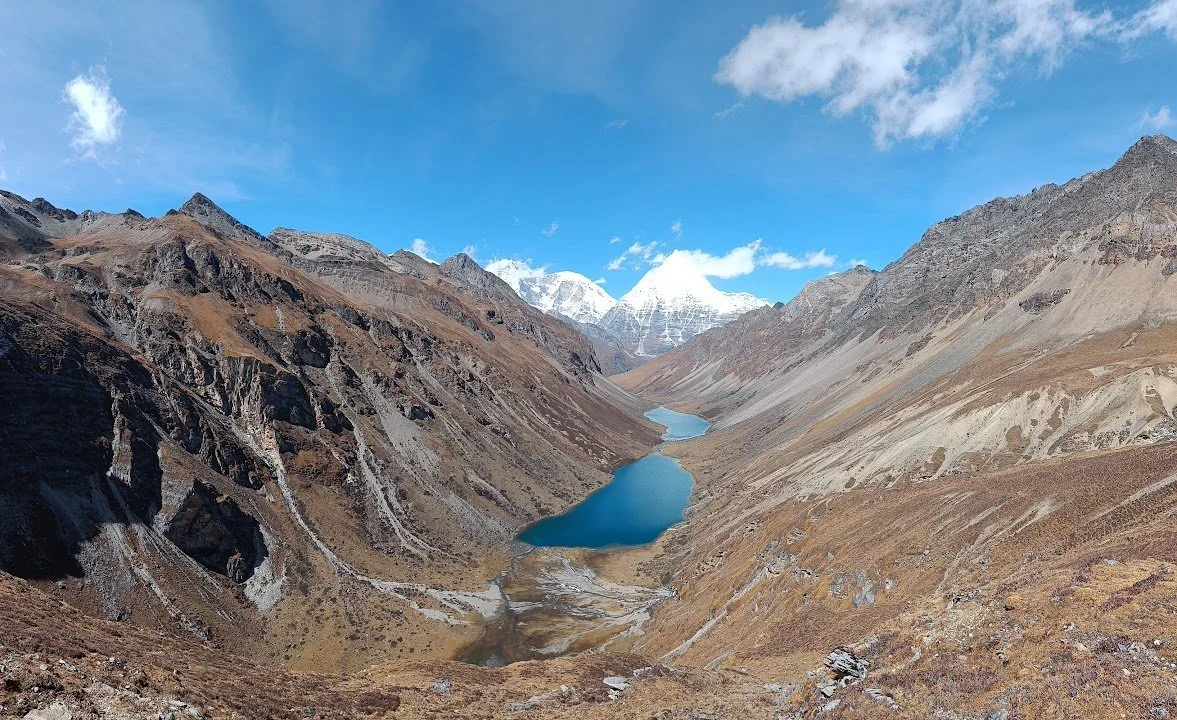
By now, we have reached our first resting place, a deep turquoise lake called Tshopu at 4,430 metres. On its shore, Pema 1 lights what I understand to be an offering fire for the marmots. The wind sweeps across the lake so fast that the smoke races over the plain in a horizontal line.
A frozen cascade
A small frozen cascade clings to the rock face above a wide slope of scree.
Tshophu, 4,430 metres
A park sign marks Tshophu at 4,430 metres, beside clear turquoise water.
Carrying the camp
A loaded mule pauses above the deep blue lake, with the rocky mountainside behind.
Above the lake
The black-and-tan dog sits above the narrow blue lake, framed by steep slopes and a snowy summit.
The baggage goes ahead
Loaded mules climb the stony slope above Tshopu, carrying the camp towards the next pass.
Following the water
A narrow trail follows a bright mountain stream through the open slopes above Tshopu.
Two lakes below
The two Tshopu lakes lie far below the trail, with Chomolhari and Jiujiudhaki at the head of the valley.
Small flower, immense mountains
A small blue flower at ground level, with Chomolhari and Jiujiudhaki rising beyond the valley.
23 October 2023
We climb higher again to the left of the lakeshore, and the path seems to grow ever steeper. When our baggage mules overtake us on the scree slope, I slip and almost fall onto the lead animal. I just manage to catch myself, but it is too much for our canine companions, who turn back. I make a ball from the first patch of snow I find and throw it towards a fellow trekker. I miss, but perhaps that is for the best.
Now dogless and far above Tshopu, we pause briefly for a drink. Here the valley branches off to the southeast. With a pang of regret, I say goodbye to Chomolhari and Jiujiudhaki, still clearly visible from here, resplendent above the turquoise glacial lakes, but soon to disappear behind the valley walls. To mark our farewell, we take a few silly photographs in which Pema 1 and I are “flying”.
23 October 2023
Pema 2, who carries our lunch and drinks every day, now leads the group with me, and we soon leave everyone else behind. For the first time, we have a proper, lengthy conversation. He offers to show me around the country, which he knows better than the back of his hand, if I return. For a moment, I am reminded of Tintin in Tibet, in which a Buddhist monk has a vision announcing the arrival of a man with a pure heart accompanied by a little white dog. I quickly dismiss the thought, because the dog accompanying me was neither small nor white and, in any case, is no longer here. Together we find a place to rest in a riverside meadow, to relieve Pema 2 at last of the lunch he has carried all this way. While we wait for the others, I photograph the abundant flowers I take to be gentians, growing around us.
A valley opening
A stream winds through the broad, treeless valley on the climb towards Bongteyla Pass.
23 October 2023
Uphill again. Less steeply than yesterday, but steeply all the same, the path climbs the mountainside towards the pass. Snow-covered peaks appear beyond the valley walls again, nameless and unknown. Once more, I begin to feel my legs. My heart is in my throat, and I can feel every pulse beating through my aching head. It is almost worse than yesterday, despite the gentler pace and the acclimatisation.
Suddenly, Chomolhari and Jiujiudhaki peep out from behind the rock wall behind me once more. How could I have been foolish enough to think that two such colossal, shapely mountains, lying so beautifully side by side, could vanish from my life completely and for ever? Lustful and unclothed, the Himalaya presents her most beautifully formed curves to me one last time, curves she so often keeps carefully veiled in white lace. In my delighted excitement over these sexy mountains, I almost forget my headache. Pema's question about whether everything is all right tears me out of my rapture. Perhaps I am hallucinating in the shortage of oxygen.
A little later, I am the first in our group to reach the Bongteyla Pass at 4,902 metres. Pema 2 was there before me, of course, but that does not count. An icy wind blows up here. I walk three times around the stupa marking the pass with Pema, take a few photographs, wait for the rest of the group and soon hurry on. To reach our next camp, we must descend into the next river valley, all the way down to 3,800 metres.
Blue beside the path
Brilliant blue, trumpet-shaped flowers among dry grasses on the climb to Bongteyla Pass.
Bongteyla Pass
The sign at Bongteyla Pass marks 4,902 metres: the highest pass of the trek.
The other side of the pass
Beyond Bongteyla, the ground drops into a new valley enclosed by sheer cliffs and jagged ridges.
Flags in the high wind
Prayer flags stretch between stone cairns at Bongteyla Pass, with snow-streaked peaks beyond.
A little violet cluster
A cluster of small violet flowers beside the trail down from Bongteyla Pass.
Yak pasture
A shaggy yak grazes below snow-dusted ridges on the descent towards Yaktsa.
23 October 2023
Quickly but carefully, using my poles as a second pair of legs, I begin the descent. A compact mountain basin opens before us, its enclosing slopes outdoing every previous scene for sheer drama. Hundreds of ribbons of snow and waterfalls descend from sharp, precipitous peaks, giving way first to brown, then fresh green and finally forest, with another glittering stream winding among the trees. On the basin floor are yaks and blue sheep; I also pass another group of walkers. Only the view of Piz Bernina, which I enjoyed on a journey on the Bernina Express last August, offered comparable drama.
Progress is much easier and more pleasant than yesterday: there is a proper path, I do not have to rush, and although my feet hurt, they are no longer tormenting me. One of my companions joins me at the same pace on the descent. After only an hour, we reach Yaktsa Camp, nestled comfortably in the valley beside the river. I understand the name to mean yak and grass; there is plenty of both here, so it seems fitting. The mules arrived long before us, the tents are up and the tea is warm. Since we are the first to arrive, I choose a well-positioned tent, lie down inside and realise for the first time how exhausted I am.
Today was supposed to be the longest stage, and Bongteyla Pass the high point of the trek. I know that my own personal high point was the sight of those voluptuous peaks, but I suppose it is only natural that we do not all reach our peaks at the same time.
Day 6 · 24 October 2023
Yaktsa to Tongphushong
24 photographs
24 October 2023
Day 6: Yaktsa to Tongphushong
I am woken by a wet canine nose sniffing my face. I evidently failed to close the tent properly after my nocturnal excursion, and a little black friend with a brown belly, short fur and a curly tail has let himself in. First taken aback, then amused, I push him out of my tent. Outside, everything is coated in frost. I wash, stuff my soaking-wet sleeping bag into its sack and go to breakfast. If I cannot dry it today, I will freeze to death tonight. It has never been so flat and damp. Freezing to death in a wet sleeping bag would be a grim fate indeed. Before that happens, I would rather throw myself in front of the next snow leopard or black bear.
But before I depart this life, perhaps a brief self-portrait:
Packed for another day
The pack animals stand ready on frost-white ground at Yaktsa Camp.
24 October 2023
Interlude: A self-portrait
And then there is me, Tilman, 24, a medical student who always follows events attentively but has little to contribute to the conversations—not because I have nothing to say, but simply because what I experience inwardly matters more to me than sharing it with strangers. Me, who gets along with the locals and the animals and treats everyone with the same respect. Me, who knows about and can do a great many things, but none of them well: an all-purpose dilettante, you might say. And me, thoroughly prepared and equipped, but usually walking far ahead of the others.
Above the wooded valley
A tall prayer flag overlooks the wooded slopes on the morning climb from Yaktsa.
Life on the hillside
A hillside homestead and grazing livestock across the valley from the trail.
Stone and timber
A small stone building with wooden shutters stands above the forest on the climb out of Yaktsa.
Under the lichens
Long strands of beard lichen hang over the narrow woodland path.
Forest and rock
Trees fill the folds beneath steep, sunlit rock faces on the way towards Tongphushong.
A thread through the shrubs
A thin path threads between green shrubs and bare autumn branches on the sixth day's climb.
White against blue
Cotton-like white clusters on the twigs, set against the clear morning sky.
The morning's frost
Frost picks out the edges of the low shrubs before the sun reaches them.
Above the tree line
Prayer flags frame a wide view back across wooded slopes and bare mountain ridges.
24 October 2023
Day 6, continued:
We begin the day's stage with a long, gentle climb through woodland once again richly draped in beard lichens. Beyond a certain point, it consists entirely of rhododendron shrubs several metres tall, the only green-leaved plants remaining here. Beneath them grow abundant smaller rhododendrons, still studded with ice crystals. It must be an awe-inspiring sight in spring, when the mountains dress themselves in their most colourful flowers. Whether the Himalaya would also show her peaks unclothed by clouds is another question. Thankfully, my feet feel factory-fresh again today.
As soon as the first rays of sunshine reach the thicket, the ground thaws in no time and becomes a thick mud churned up by dozens of mules, giving an appreciative squelch with every step and releasing our boots only reluctantly. Alongside flowers I take to be the now-familiar edelweiss and gentians, countless pale violet, star-shaped flowers—hepaticas, I think—adorn the path. Soon we reach the tree line and, a little later, the first pass of the day, marked by a gateway hung with prayer flags. The plateau beyond, another river valley like yesterday's but narrower, gives us an unobstructed view of yet more peaks, their slopes mottled with pale grey scree, patches of brown grass and green rhododendron groves. Pema 2 and I race ahead together. The route through the riverside meadow includes a few missteps into deep water. Before long, we have found a good place for lunch, and Pema is glad to be relieved of his load.
The next climb leads to the day's final pass. I stride higher and higher in step with my new friend, but inevitably Pema pulls ahead. The increasingly thin air seems not to trouble him. Yet despite knowing that this is my last day alive, I too am in excellent shape. Suddenly Pema stops, waits for me and draws my attention to the view opening up behind us.
Pale stars along the trail
Pale lilac, star-shaped flowers brighten the dry undergrowth beside the path.
Deep blue in the sunshine
A close view of the deep blue flowers scattered along the sixth day's route.
The valley falls away
The path crosses a bare slope above a stream, with successive mountain ridges fading into the distance.
24 October 2023
I stop in my tracks, for once again the Himalaya presents herself to me, naked and voluptuous: the noble pallor of her literally breathtaking curves, the seat of her divinity and the angry bird. As I move farther away, she modestly covers herself again in her white, cloud-woven dress, apparently offended.
The peaks return
White summits emerge from the clouds beyond the dark ridge on the climb towards Takulungla.
Across the high country
A broad panorama from the ridge near Takulungla Pass, with valleys falling away on both sides.
24 October 2023
By the time I reach Takulungla Pass—Tiger Stone, as I understand the name—at 4,500 metres, Pema is again so far ahead that I can no longer see him. The group behind me is also nowhere in sight for kilometres. I take a few photographs, find a sunny spot sheltered from the wind and decide to wait for the others. Not even a snow leopard could catch Pema now. To my surprise, a bumblebee visits while I wait, finding refreshment in the pass's meagre flowers despite the stormy cold. About half an hour later, the rest of the group begins to trickle in. To fill the time while the others take photographs, and to indulge my high spirits, I climb another 50 vertical metres to the next summit. Knowing full well that this will be my last afternoon alive, I try to savour the view especially deeply. Wistfully, my limbs stiff with cold, I wave a final farewell to my two tantalising favourite mountains.
New, spectacular mountain views open up on the other side of the pass, carpets of flowers I take to be hepaticas to the left and right, blue sheep in the distance.
A visitor at the pass
A bumblebee visits a small purple flower at Takulungla Pass—the encounter recorded in the sixth day's journal.
Tonight's camp below
Tongphushong Camp appears far below, its small tents beside the winding stream.
Along the ridge
A narrow path follows the ridge away from Takulungla, with cairns and flags marking the way.
Snow above the scree
A snow-capped summit rises beyond the bare, eroded slopes near Takulungla Pass.
Flowers on the way down
Small pale flowers dot the bank beside the descent towards Tongphushong.
The sheltered basin
Tongphushong's tents sit in an open basin threaded with streams, below the surrounding ridges.
24 October 2023
I hurry to reach Tongphushong Camp at 4,200 metres, already visible from the pass, so that I can still dry my clammy sleeping bag in the sunshine. In the basin of the plateau, it is pleasantly warm and sheltered from the wind.
I settle into a camping chair in the full afternoon sun, sip my chocolate tea and write in my adventure journal as the shadows grow longer. When the sun slips below the horizon and the familiar cold returns, I retreat to my tent and settle in. Unfortunately, I have encountered neither a bear nor a leopard today.
Looking beyond camp
From above Tongphushong, the view follows a steep green valley towards layers of distant mountains.
24 October 2023
On this final evening of the tour, I am tasked with collecting and presenting the tips. On my rounds from tent to tent, I see nomads driving a herd of yaks onto the plain. In the distance, a little cat bounds across the meadow; to the west, a pair of black dogs are romping about and intermittently having wild sex. I quickly fetch my camera and capture the orange clouds and peaks and the piebald yaks on its sensor. Unfortunately, this brings me too close to the dogs. Suddenly, they no longer seem quite so affectionate, especially towards me. They pause briefly. The tethered female starts barking wildly; her partner promptly joins in and runs towards me in a threatening manner. Apparently, dogs do not appreciate coitus interruptus either. Before I have grasped the situation, my legs are already carrying me as fast as they can through the marsh. My shoes are undone and threaten to remain stuck in the mud with every step. I am fast, but with every second the dog draws closer. Perhaps I still have a chance to be torn apart by a predator before the night's cold robs me of my soul. For a moment, I consider slowing down. Then Pema 1 leaps out of the kitchen tent and, with a mighty roar, sends the terrifying barker packing.
Yaks at dusk
Yaks graze beneath a pink evening cloud at Tongphushong, on the last night of the trek.
24 October 2023
At our final dinner, I ask the whole team to join us for dessert, a cake baked over the fire. Once everyone has made their speeches of thanks, and I too have put my thoughts into my most poetic words, one of our companions astonishingly manages to divide the cake into exactly the 13 pieces we need. I hand over the tips, and the six Bhutanese members of the team bid us farewell with improvised dancing and singing. Bhutanese music is fascinating in its unfamiliarity, but it is not at all easy for my ears, trained on Western music, to follow, even though I occasionally treat them to a little Chinese kitsch. To paraphrase the song: wherever people live, they give their own musical expression to the world. We return the gesture with a few rounds, and for the first time in a long while I get to present my resonant singing voice to an astonished audience.
The ground and my water bottle are already frozen solid. Full and content, I squeeze into my flattened sleeping bag, make my peace with life and fully expect never to wake up the following morning.
The last evening sky
The moon hangs over Tongphushong as the light fades beyond the ridge.
Day 7 · 25 October 2023
Tongphushong to Shana
16 photographs
25 October 2023
Day 7: Tongphushong to Shana
I am still alive! Admittedly, I am now a cold-blooded creature, a White Walker, a snowman, a frozen vegetable—but despite everything, I am alive! “Tip-top, eh?” a Swiss person might say. This morning also marks the beginning of our trek's final day, and to bring the story of my adventure to a close, I would like to try honouring this place's extraordinary mystique in a poem. This time, though, without ChatGPT or help from the internet: neither is available out here.
Morning on the plateau
Clear skies above Tongphushong on the final morning, before the long descent towards Shana.
25 October 2023
The Himalaya casts her spell on me, bright flags flutter high above; sadly, I am here without you, and a dog keeps me company.
You cast your shadows, full of mystery, two peaks of divinity; long ago, the monks already understood your sacredness.
Yaks, horses and mules, my friends at every turn, but not the ones I long for in the valleys and the mountains' solitude.
The magic and splendour of the highest mountains leave more than monks in awe. Here, giants seem like dwarfs; it is good to be human here.
On the very highest summits lives the soul of our world; they form the foundations and pillars that hold East and West together.
Every stupa, every temple radiates its magic, even amid the city's crowded bustle; even the cattle are sacred.
Bhutan, Nepal and Ladakh, where Buddhism lives in time-honoured ways, with all their powers of enchantment, are always worth the journey.
White woolly stars
White, woolly, star-shaped flower heads among the dry grasses on the final day's climb.
One more flagged ridge
Prayer flags pull in the wind above the final day's ridge trail.
Autumn's red
A vivid red shrub stands above green slopes and distant peaks on the way back towards Shana.
The high peaks behind us
Snowy summits peek over the brown ridges, while green shrubs fill the foreground on the final day's route.
Silver in the sunlight
A dense cluster of woolly white flower heads catches the sunlight beside the trail.
Blue flowers, high mountains
Low blue flowers surround the rocks, with a snow-topped mountain beyond.
Room for the mule
A loaded mule picks its way down the narrow, rocky path, baskets balanced on either side.
A path through blue
Small blue flowers line the pale ridge path as the route begins to descend towards the forest.
A patchwork underfoot
Deep blue flowers and pale lilac stars grow together among russet leaves and dry grass.
Framed by the forest
The returning trees frame one more view of a snowy summit above the path.
25 October 2023
While washing this morning, I make a remarkable discovery about an advantage of bar soap over the liquid variety: this one, at least, has not frozen! In wonder, I remember last night's wild dreams.
Soon we set off again. A short climb takes us up to 4,500 metres. Up here, flowers I take to be edelweiss, gentians and hepaticas are abundant once more. Among them are what look like alpine lady's mantle and fields of crimson heather, adding deep red splashes to the mountainsides' browns, greys and various shades of green. For a while, we walk along the level ridge, where the Himalaya shows me Chomolhari naked one more time: that pale breast. By now, we have seen each other naked so often that neither of us feels any shame.
Today promises a descent of 1,600 vertical metres, and from the heights and the ridge's final epic views, both climate and vegetation change rapidly. As it grows warmer, the rhododendron shrubs grow taller. Just as at the beginning of the trek, ferns and beard lichens become more numerous again. There are colourful flowers and bees, and with every breath I can feel the sun's warmth and the density of the air. The flowers I take to be gentians, previously a deep blue, now appear in a pale sky blue, growing in dense, fresh green cushions.
Purple among the ferns
A purple, daisy-like flower stands among the fresh green ferns of the lower slopes.
A paler shade of blue
Pale blue, bell-shaped flowers grow in green cushions along the descent—the softer blue noted in the final day's journal.
Down towards the trees
The narrow trail crosses an open slope above a valley densely covered in forest.
A forest encounter
A brown-and-white cow stands among ferns beside the woodland trail.
25 October 2023
Deep in conversation with Pema 2, I bound down the mountain alongside him. My feet, utterly wrecked and falling apart, hurt, but I do not care: it is the last day.
By the time we sit down for lunch, the trees have reached a very impressive height. We enjoy our Tibetan cook's skills one last time while our baggage mules overtake us.
Before the others have finished chewing, Pema and I are already bounding onwards. Our conversation turns to wildlife in Germany, where there are no wild tigers, elephants or takins. A short time later, we reach the end of the trek, where one of our companions is already waiting for me. Our team quickly unloads the mules, and the muleteers move on. Once the rest of the group has arrived too, there is a brief exchange of gifts: one of the group gives Pema 2 his boots and pocketknife; another gives the cook her leather gloves, one assistant her hat and another a knife.
Without ceremony, we part from the team, collapse into the seats of our minibus and set off.
Back above the fields
A white-walled hilltop complex overlooks village houses and terraced fields after the trek.
25 October 2023
The route in numbers
My recorded route covers 69.2 kilometres, with 3,920 metres of ascent and 3,960 metres of descent.