
Ventura & Atomic Wedge
Ventura and Atomic Wedge are two watchfaces I designed for the new generation of Pebble watches, both drawing on the optimistic geometry of mid-century space-age design. They share a visual language of sharp forms, restrained color, and highly legible information, but take two very different approaches to the watch face.
Ventura
Atomic Wedge
A crisp digital watchface built around bold geometry.
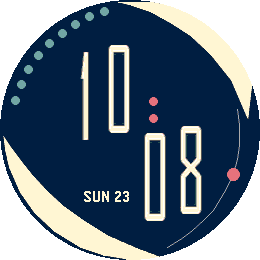
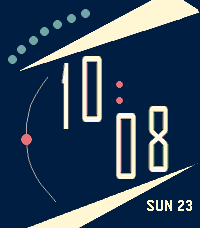
Ventura pairs oversized split numerals with sweeping asymmetric forms inspired by mid-century futurism. The composition is intentionally graphic, using the shape of the display as part of the design rather than simply placing a rectangular interface inside it.
Alongside the time, Ventura keeps the essentials visible at a glance: day and date, battery level through a row of mint dots, and a moving coral seconds indicator.
The layouts for Pebble Time 2 and Pebble Round 2 are designed independently, allowing the asymmetric geometry to make full use of each watch's 64-color display rather than simply scaling the same face between screen shapes.
Ventura automatically follows the watch's 12- or 24-hour setting and runs entirely on the Pebble itself. There is no companion app, phone connection, or configuration required.
Pebble Time 2 · Pebble Round 2 · 64 color · Fully offline
An analog watchface where the dial itself becomes information.
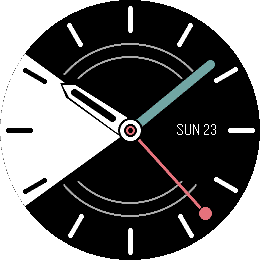
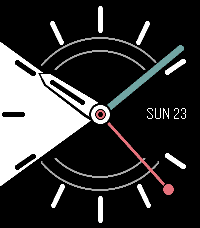
Atomic Wedge starts with a more traditional analog face and gives it one deliberately unconventional element: a large moving sector cut into the dial.
That wedge is not just decorative. It can represent useful information directly on the watchface, turning a bold piece of geometry into something glanceable and functional.
It can visualize steps, activity, sleep, battery, daylight, rain, alarms, focus sessions, calendar events, and more. The result can be as minimal or as information-rich as you want while preserving the same distinctive underlying design.
Atomic Wedge also offers considerably more customization than Ventura, including wedge motion, update intervals, colors, displayed data, and seconds-hand behavior.
Its visual language draws on atomic-age instrument panels, clocks, and technical diagrams: radial markings, exposed geometry, and a strong asymmetric interruption of the otherwise familiar analog dial.
Analog time · Configurable data wedge · Activity & contextual information · Customizable appearance